 xyh@xiongyihua-plastic.com


Why Choose 3240 Epoxy Fiberglass Laminate? (And When It Beats Fancier Alternatives)
Time of issue: 2026-06-26
You've seen the yellow sheet in every transformer workshop. Maybe you've called it "3240," maybe just "yellow epoxy board." But have you ever stopped to ask why this old-school Chinese standard (GB/T 1303) is still the go-to for thousands of motor and switchgear shops worldwide—even when FR-4 and GPO-3 are sitting on the same shelf?

Spoiler: it's not just about being cheap. It's about the sweet spot where mechanical strength, dielectric performance, and price actually make sense for real-world jobs.
Let's talk about what 3240 reallyis, where it shines, and why Shenzhen Xiongyihua keeps stocking it in full sheets and CNC-machined parts for global buyers who know the difference.
First Off—What IS 3240, Exactly?
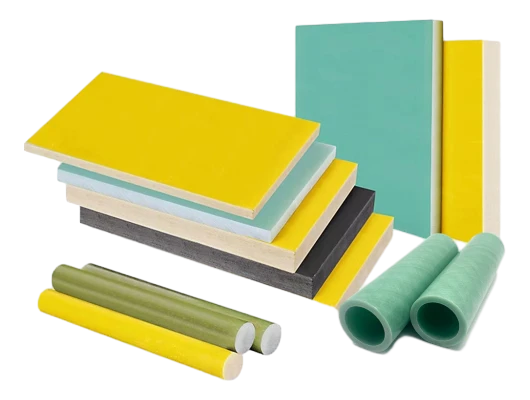
3240 is an epoxy phenolic glass cloth laminated sheet. Take alkali-free (E-glass) woven fiberglass cloth, dip it in epoxy resin (sometimes with a touch of phenolic for heat resistance), bake it, and hot-press it into a rigid board. That's it. No halogen-free flame retardants. No fancy low-Dk tweaks for RF circuits.
The result? A dense, yellowish laminate that's:
•Class B insulation (continuous ~130°C, short-term to 155°C)
•Non-flame-retardant (HB grade, notUL 94 V-0 like FR-4)
•Excellent dielectric strength — typically ≥14–18 kV/mm perpendicular to laminations
•Machinable as heck — drills clean, saws smooth, barely dulls your bits
It's the Chinese national standard equivalent of NEMA G10/ IEC EPGC 201.
If you know G10, you basically know 3240.
So… Why Pick 3240 Over FR-4 or G10?
Good question. FR-4 gets all the hype because it's flame-retardant (V-0) and RoHS-friendly. But 3240 has three very real advantages that matter on the shop floor:
1. It Machines Cleaner (Seriously)
FR-4's brominated flame-retardant fillers are abrasive. They heat up your carbide bits and leave fuzzy edges if you're not careful. 3240? No FR additives, so it cuts like butter. Clean holes, smooth edges, less tool wear. For high-volume punched or CNC-drilled insulation spacers, terminal blocks, and fixture bases, that matters.
2. Better Bang for Your Buck
3240 typically costs 20–40% less than FR-4 of the same thickness.
If your application doesn't require V-0 flame retardancy—think oil-immersed transformer components, internal motor end plates, or jig bases—why pay the FR-4 premium?
3. Proven in Oil & Humid Environments
3240 holds its electrical properties well even in damp conditions or immersed in transformer oil. Low water absorption, stable insulation resistance after 24h immersion.
That's why it's still the default for many low-voltage switchgear barriers and transformer insulation pads where flame spread isn't a concern.
Where 3240 Earns Its Keep (Real Applications)
You'll find it in places like:
•Motor & Generator Insulation — slot wedges, phase barriers, end laminations
•Oil-Immersed Transformers — insulation cylinders, support blocks, barrier plates
•Low-Voltage Switchgear — phase separators, busbar supports (when flame rating not mandated)
•Test Fixtures & Jigs — drill plates for PCB test beds, backing plates for CNC where flatness + rigidity matter more than flammability
•General Industrial Panels — insulating washers, spacers, mounting blocks
If your design requiresUL 94 V-0 self-extinguishing behavior (enclosed electronics, export appliances to EU/US with fire-code compliance), step up to FR-4. But for the rest? 3240 is plenty.
3240 vs. FR-4 — Quick Reality Check
| Property | 3240 (GB/T 1303) | FR-4 (NEMA LI-1) |
| Flame Retardancy | HB (burns) | UL 94 V-0 (self-extinguishing) |
| Thermal Class | B (130°C) | B–F (130–155°C typical) |
| Dielectric Strength | ≥14–18 kV/mm | ≥14–16 kV/mm |
| Machinability | Excellent (low tool wear) | Good (FR additive = more abrasive) |
| Water Absorption | Low | Very low |
| RoHS / Halogen-Free | Usually contains halogen | Available halogen-free |
| Relative Cost | Lower ★ | Higher |
Bottom line: 3240 = workhorse. FR-4 = upgraded safety + compliance.
The Xiongyihua Edge on 3240
We don't just resell random yellow sheets. At Shenzhen Xiongyihua Insulation Materials Co., Ltd., our 3240 epoxy fiberglass laminates are:
•Produced to GB/T 1303.1-1998/ EPGC 201 spec, with full QC on thickness tolerance and flatness
•Available in standard 1020×2020mm or 1220×2440mm sheets, thickness 0.5–50mm+
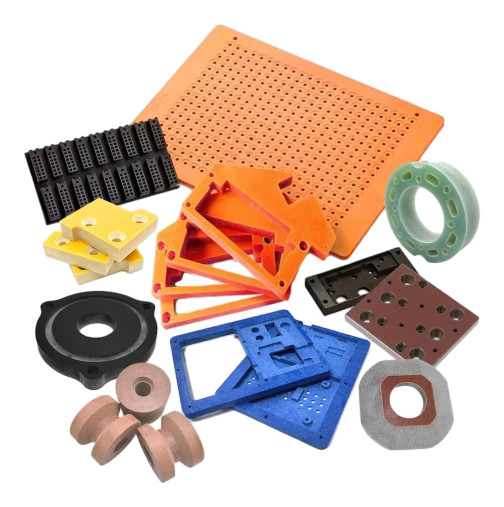
•CNC custom-machined to your drawing — drilled, counterbored, milled, or profiled — with ±0.1mm typical tolerance
•Supplied with material test data on request (flexural strength ≥340 MPa, breakdown voltage, etc.)
•Shipped globally, with export packaging that won't let your sheets warp or get edge-chipped
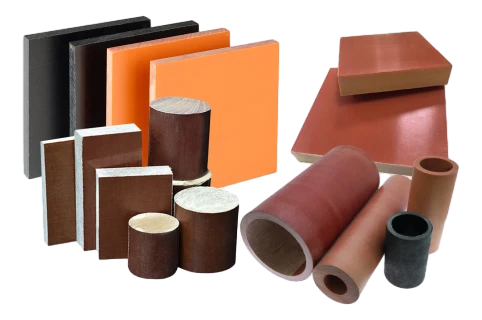
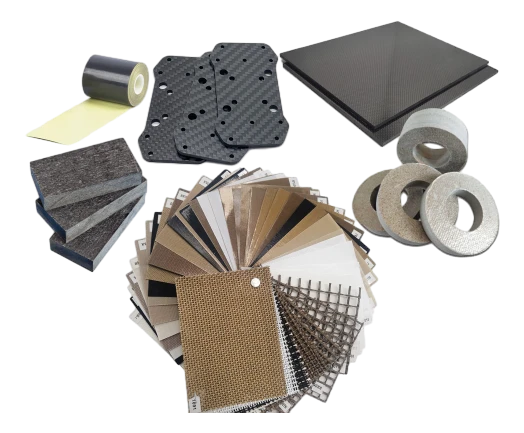
We also stock FR-4, phenolic cotton cloth (3025/PFCC), Nomex-type aramid, and engineering plastics (POM, PEEK, UHMW-PE) — so if your next project doesneed V-0 or chemical resistance, we'll steer you right.
One Honest Caveat (Don't Skip This)
3240 is not flame-retardant. In an enclosed cabinet where a fault could ignite and spread, check your local electrical code beforespecifying it. And if you need halogen-free/RoHS-compliant documentation for EU import, confirm that upfront — standard 3240 usually contains halogenated resin.
Use the right tool for the job. For general-purpose, high-mechanical, cost-sensitive insulation where fire rating isn't the gating factor? 3240 is still king.
Ready to see the quality for yourself?
Request a free 3240 sample or upload your CAD drawing for a machined-part quote → [Contact Shenzhen Xiongyihua]
FAQs: 3240 Epoxy Glass Cloth Laminate
Q1: Is 3240 the same as FR-4 or G10?
Not exactly. 3240 is the Chinese GB standard equivalent to NEMA G10/ IEC EPGC 201 in mechanical & electrical performance, but it lacks the flame-retardant (V-0) additive that defines FR-4. If your project requires UL 94 V-0 self-extinguishing behavior, choose FR-4 instead.
Q2: Can 3240 be used inside oil-immersed transformers?
Yes. It's widely used for barrier plates, support blocks, and insulation cylinders in transformer oil. Its dimensional stability and dielectric strength hold up well in that environment.
Q3: What's the maximum working temperature for 3240?
Continuous operation is rated Class B (~130°C). Short-term exposure up to ~155°C is possible, but prolonged overheating will cause darkening and gradual property loss. For sustained >155°C, consider Class F or H materials.
Q4: Does Xiongyihua supply 3240 cut to size or with CNC machining?
Absolutely. We supply full sheets and offer precision CNC cutting, drilling, and profiling per your CAD/DXF file. Tolerances of ±0.1mm are standard; tighter is available on request.
Q5: Is 3240 RoHS compliant?
Standard 3240 formulations typically use halogen-containing epoxy systems. If RoHS / halogen-free certification is required for your market, please specify that when requesting a quote — we can advise on available options or recommend an alternative grade.
Previous
Contact Us



Company Headquarters
NO.2 Longxian Road, Xinsheng Community, Longgang Street, Longgang District, Shenzhen, Guangdong, China